PART 2 — The Rescue That Changed Everything
The last thing I remember before everything went dark was his voice calling my name through the storm, not like a stranger, but like someone who had been searching for me long before I ever fell.
“Emma…”
It didn’t feel like a name in that moment, but like recognition, as if he was speaking to someone he already knew rather than someone dying on a frozen mountain cliff.
Then everything disappeared, not slowly or gently, but instantly, as if the world had cut itself away from me and left only silence, cold, and fading consciousness.
I drifted in fragments after that moment, losing track of time, sound, and even the feeling of my own body as the mountain storm swallowed everything around me completely.
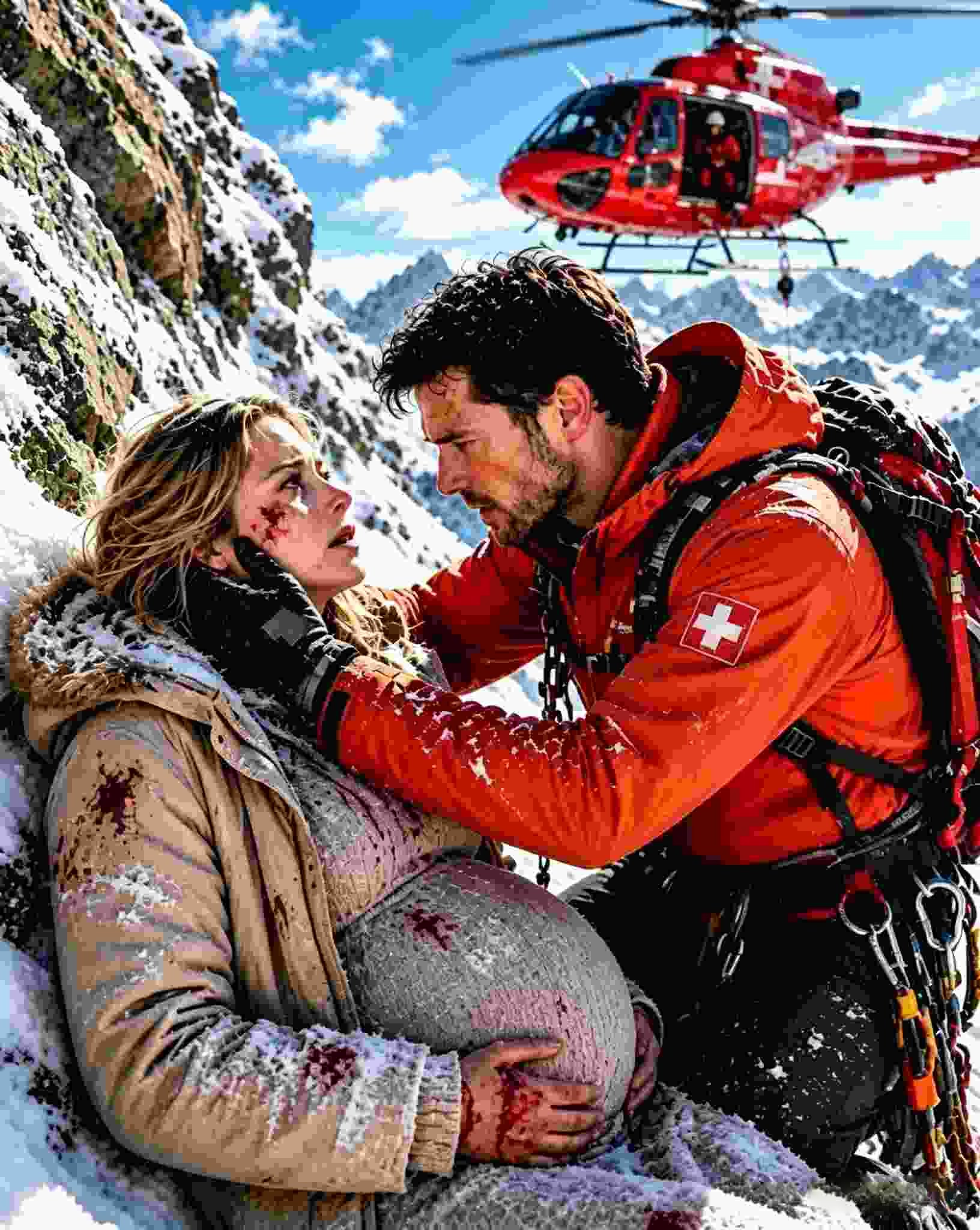
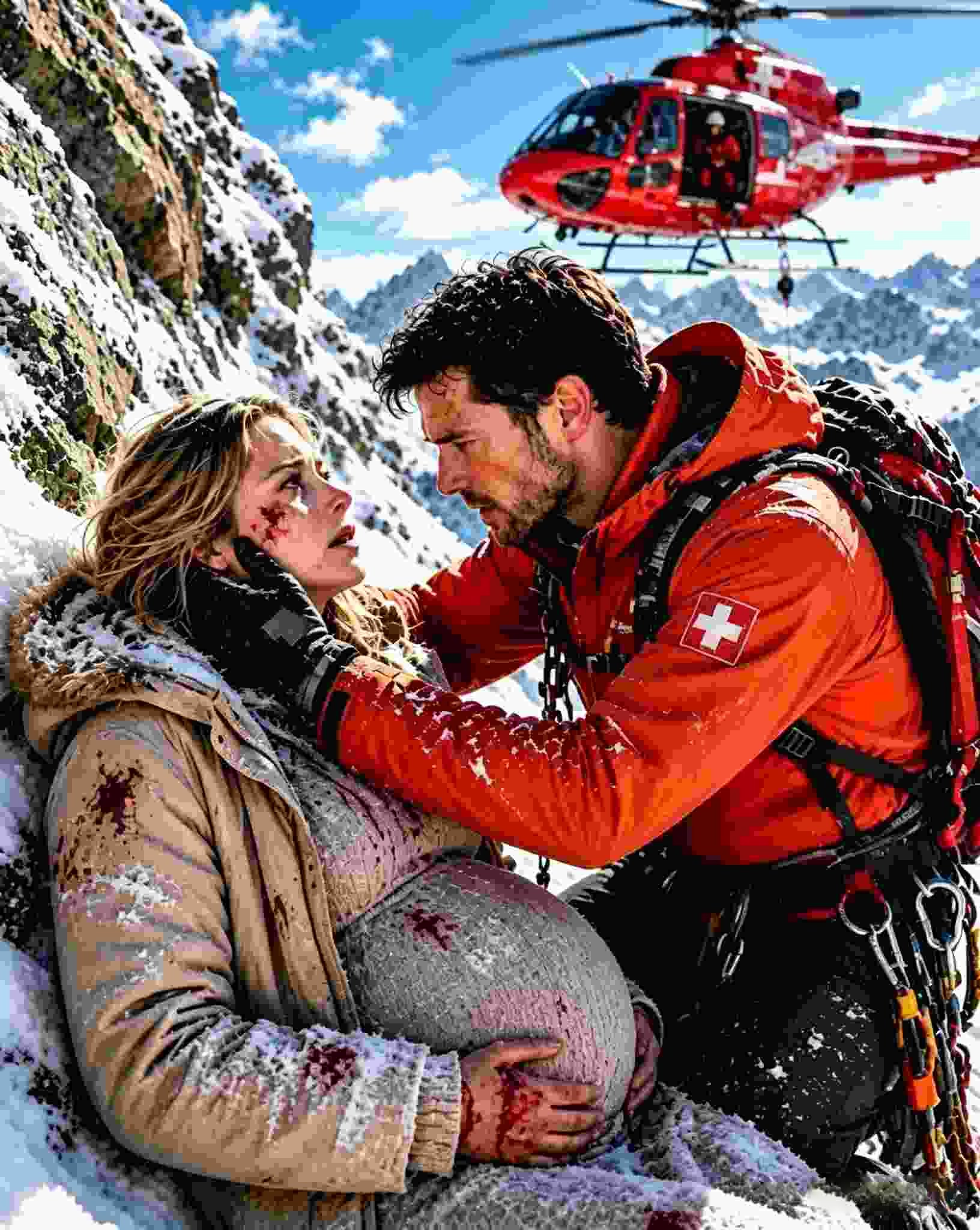
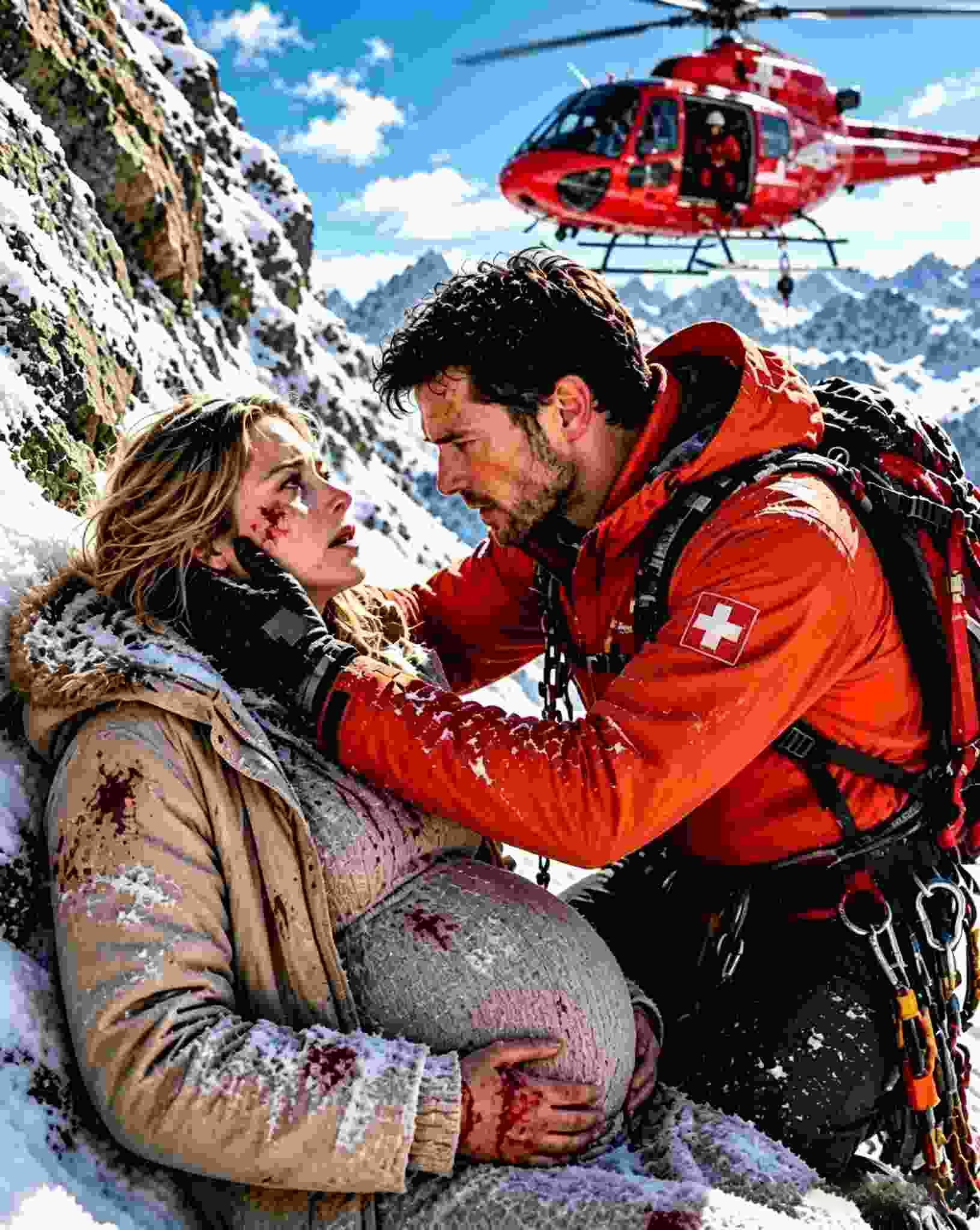
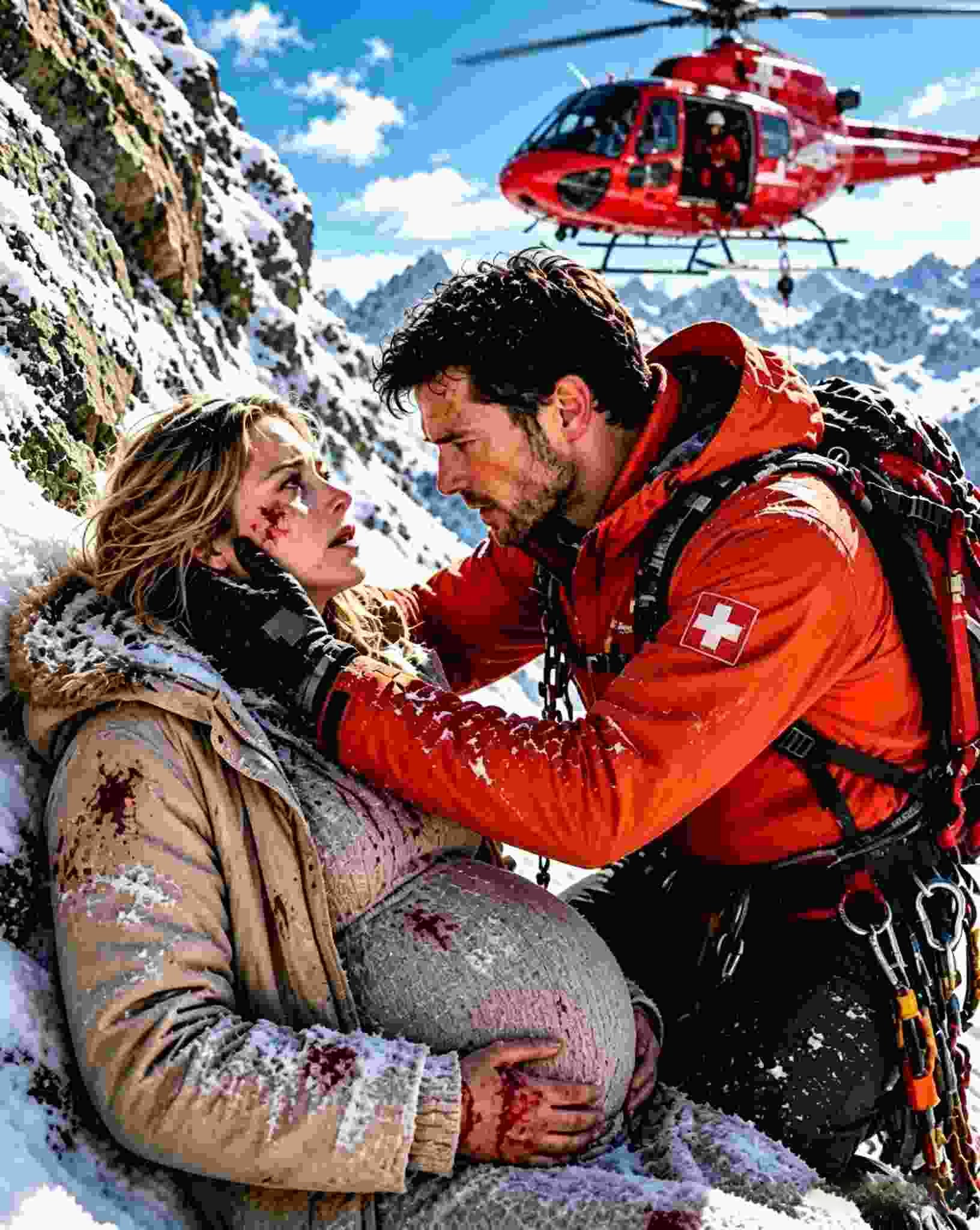
Cold came first, then light, then noise, then hands lifting me from the snow, as if I was being pulled back from somewhere I was never meant to return from.
A mask was pressed over my face, and I heard voices shouting through wind and static, speaking words I could barely understand through the collapsing edges of consciousness.
Pregnant female, severe hypothermia, possible internal trauma, prepare for immediate evacuation, we are losing her fast.
The helicopter did not feel real at first, like something built from desperation rather than reality, as if the mountain itself refused to let me leave easily.
Straps tightened around my body, securing me in place, but I was already slipping away from awareness, drifting between survival and something much quieter and darker.
Somewhere in that fading space, I felt movement inside me, a small and fragile kick that broke through the darkness like a signal from another world entirely.
My baby was still there.
That thought became the only thing strong enough to hold me inside my body, even as everything else tried to pull me out of it.
Stay with me, I whispered silently, though I was not sure if I still had a voice, or if I was already gone in every way that mattered.
The next time I opened my eyes, the world had changed completely, no longer snow, wind, or mountain silence, but bright, sterile hospital light that hurt more than the cold ever did.
Machines beeped steadily around me, marking a rhythm I could not yet understand, as my throat burned and my chest felt like it had been crushed inward.
My body felt stitched together from pain and numbness, as if it belonged to someone else who had survived something I could not fully remember.
I tried to move my hand, and it responded slowly, as if the connection between thought and body had been damaged by everything that had happened.
For a terrifying moment, I could not feel my stomach, and panic rose instantly inside me like a wave I could not stop.
No, no, no, please no.
Then I looked down.
It was still there.
Barely.
But still there.
A nurse appeared beside me quickly, her voice calm but urgent, telling me I was safe now, that I was in the hospital, that I had been rescued from the mountain.
Safe was a word I no longer trusted, because nothing about what I had just lived through felt like safety in any form I understood.
“My baby,” I whispered weakly. “Where is my baby?”
The nurse hesitated for only a second, but that single hesitation felt like it lasted an entire lifetime inside my chest.
Then she nodded quickly and said the words that shattered and rebuilt me at the same time.
He is alive.
The room tilted for a moment, not physically, but emotionally, as if my entire world had lost its balance and was trying to correct itself too fast.
She continued speaking softly, explaining that he was small, that he had been delivered early after I arrived, and that he needed help breathing but was stable now.
I stared at her, unable to process language properly, as if my brain had not yet caught up with the fact that my child had survived the fall with me.
Alive, I repeated, almost disbelieving the word as if it belonged to someone else’s story instead of mine.
Yes, she said again gently, he is alive.
Later, the doctor came in, speaking carefully as if every word had weight and consequences, explaining the severity of my injuries and how close I had been to not surviving the night.
Multiple fractures, severe hypothermia, internal trauma, blood loss, the kind of injuries that should have ended everything under normal conditions in that environment.
I barely heard most of it, because my mind was still locked on one thing alone, the fact that my baby had survived the impossible alongside me.
The doctor asked if I had chosen a name.
I turned my head slowly toward the window, where the storm outside had disappeared, replaced by a quiet morning sky that felt unreal after what I had just lived through.
Lucas, I said softly, without hesitation, as if the name had been waiting for this exact moment to finally become real.
The doctor nodded and wrote it down, as if recording the first piece of a life that had almost been erased entirely.
That afternoon, the door opened again, and the man from the helicopter stepped inside slowly, as if unsure whether I was truly awake or still somewhere between survival and unconsciousness.
He wore no rescue gear now, only a dark coat over hospital clothes, but I recognized him instantly from the moment he entered the room.
He stopped a few feet from my bed, watching me carefully, as if trying to confirm something only he could understand.
“You’re awake,” he said quietly, not as a question, but as a fact he had been waiting to hear confirmed.
I studied him carefully, noticing details I could not see clearly during the storm, the silver hair, the controlled posture, the age that suggested experience shaped by something far heavier than simple rescue work.
“Who are you?” I asked, my voice weak but steady enough to demand an answer.
He did not respond immediately, and that silence felt heavier than anything he had said so far.
“My name is Richard Vale,” he finally said, and the name meant nothing to me at first, but his expression told me it should have meant everything.
Then he added something that changed the air in the room completely.
I knew your mother.
My body went still instantly, as if the temperature inside the room had dropped several degrees in a single second.
My mother is dead, I said quietly, trying to understand why a stranger would say something so impossible so calmly.
I know, he replied, and his voice carried something between regret and recognition, as if he had been carrying that truth for a very long time.
I asked how he had found me, and he hesitated before answering, saying he had been watching my husband for months, as if that explained everything and nothing at the same time.
Watching Daniel, I repeated slowly, trying to understand why my life had been under observation without my knowledge or consent.
He said he believed Daniel might hurt me, but he did not know how far it would go, or how close he already was to completing something irreversible.
Something inside me shifted at that moment, not fully understanding yet, but sensing that nothing about my life had been as simple as I believed.
Then I asked why he had called me Emma, and something changed in his expression immediately, like a door inside him had opened slightly without permission.
He said it was what my mother had called me, but I immediately rejected it, because my mother had never used that name for me in my memory.
He looked down and said quietly that she had wanted me to forget certain parts of my life, and that sentence stayed in the room long after he stopped speaking.
Then he reached into his coat and pulled out an old envelope, worn at the edges, carefully preserved as if it had been waiting for this exact moment for years.
My name was written on the front in handwriting I recognized instantly, even before I accepted what it meant or why it was in his possession.
He said my mother left it for me before she died, and that he had carried it for a long time before finally deciding I was ready to see it.
I did not take it immediately, because something about it felt heavier than paper, as if opening it would change more than just information.
He said something that stayed with me more than anything else that day, that my husband had not found me by accident, and that I had been targeted from the beginning.
The word targeted settled inside me slowly, like something cold spreading through a place that had once felt warm and safe.
And for the first time since I fell from the cliff, I began to understand that survival might not have been the end of my story, but the beginning of something far more dangerous.